Posts

The Olde Country Cottage
Image
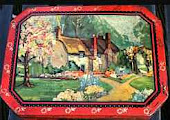
Country cottages. Warped ships' timbers, honeysuckle, pixie-cut thatched roof,  a misshapen chimney, the aroma of baking and  Vaughan Williams 'Pastoral' drifting out of the small paned window. Very twee.  Do you ever wonder whether they are really ancient or just more recent fakes?  This post is about the oldest, visible, surviving rural housing used by the common people and in particular, how much you can see from the road. It is impractical to include much detail in a post aimed at mobile phone readers, so  I have added notes and links in a postscript i n case you want to peek behind the floral curtains and take a closer look.  It isn't easy. Timber was the common building material and it lasts well, but the main survivors from medieval times are the stone buildings, like churches and mansions, which I am not concerned with here. There are few details, let alone complete houses, that have survived e xtensions, reconfigurations and improvements; and no c...

3. Mud

Image
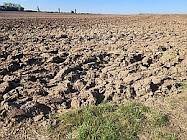
Our regional landscape has its origins in mud on the seabed, so at this point in our trudge through the stygian gloom of geological history, let us take a closer look at that  gloopy, crumbly  mud and the various types of stone that it morphed into.  Apologia. The passively interested reader might find this post sultifyingly tedious . Even the  graphics are awe-inspiringly uninspiring.  It is here  for the sake of completeness and  because, worryingly, I think that mud has a story to tell.  On its travels around the planet, detailed in the previous posts, South East England often found itself either under or above water, or in a liminal zone between the two. What we see today is based on the compacted sediments of sand, gravel and biological detritus that slowly accumulated on the old sea floors. Under their own weight and the water above them, they turned into stone.  The different types of stone are the result of different mixtures of mater...

4: The Chalk

Image
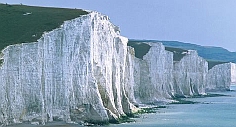
  Brass Point nr. Beachy Head I introduced the Chalk in my previous post.  Rolling hills  of pure white stone  surround London and the Thames Valley. T he Chilterns and Downs are  'ancient' country, the 'bleached clean bones of old England' and  Tolkien's Barrow Downs.   Wonderful stuff.  There aren’t many places in the world where pure chalk rises to the surface, and most of them are in England.  If you are walking, it is usually dry and springy underfoot and on a bike the slopes are merciful. Cretaceous Earth Its origins are described in the first two posts in my 'Deep Past' series; Links: ' From Hell to High Water '  and ' Coming Up For Air '.  A short reprise. The chalk was formed at the bottom of an ancient sea at  around the same latitude where you now find North Africa. Sharks swam in it, crabs scuttled along the bed, and coiled carnivorous cephalopods called ammonites floated about.  Then as now, at the bottom of t...